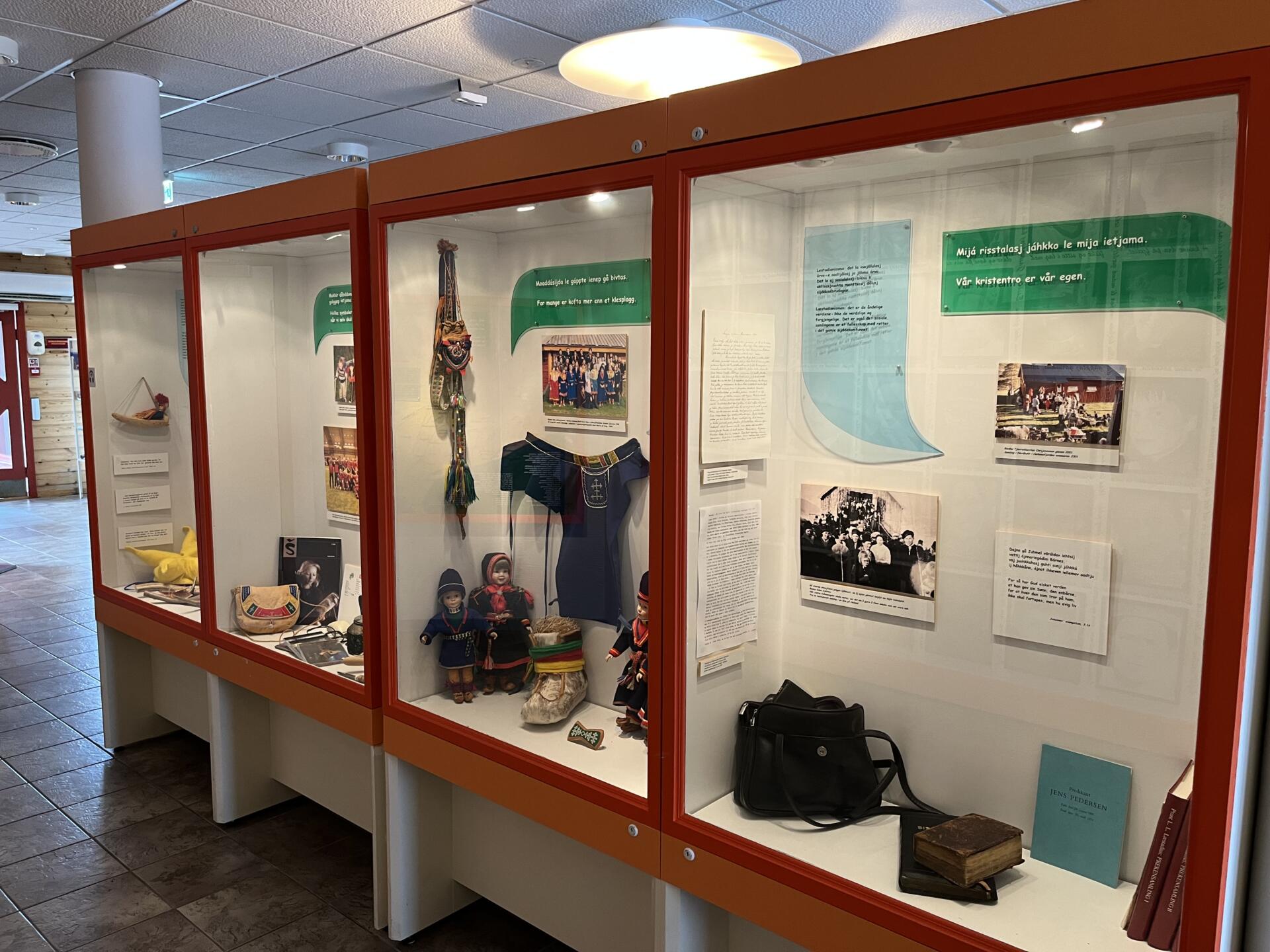

Showcases on identity
The sequence of showcases on this floor forms a visual and thematic progression — a conversation about Sámi identity, and about how the Sámi have been viewed by others throughout history, as well as how Sámi individuals represent themselves today.
1) How Others Have Seen the Sámi
The first showcase examines historical portrayals of the Sámi by outsiders. These representations range from fascination and romanticism to prejudice and scientific racism.
One early account comes from Adam of Bremen, an 11th-century German chronicler, who wrote:
“They can outrun wild animals through high snow.”
He was not alone. Over centuries, the Sámi have been described — and often misrepresented — through the lenses of outsiders. Some accounts reflect curiosity or admiration. Others are rooted in misunderstanding, fear, or attempts to categorize and control.
A 6th-century Greek historian, for example, claimed that Sámi mothers suspended newborns from trees while hunting. In the 19th century, a Norwegian scholar attributed poverty among Sámi families to supposed “racial weakness.” Others speculated that Sámi individuals could “fly” over the snow — a misinterpretation of traditional skiing techniques.
The objects and texts in this display present a selection of these stereotypes, demonstrating how Sámi people have been framed and defined by external narratives.
These perspectives continue into the present. Despite increasing recognition of Sámi diversity, the tendency to reduce Sámi identity to a single, unified image persists.
2) Sámi Identity and Self-Representation
The second showcase shifts the focus to Sámi perspectives. Here, Sámi individuals have selected personal objects that reflect their own identities, memories, and values.
These items are diverse — some are traditional, others contemporary. Some are inherited, while others are uniquely modern. Together, they reflect the multiplicity of Sámi experience and expression.
Each object tells a story — about family, creativity, continuity, or change. Collectively, they offer a clear message: Sámi identity is not a stereotype. It is many things, expressed in many ways.
3) The Gáppte – Clothing as Cultural Expression
The third section centers on the gáppte — also known as the kofte — the traditional Sámi clothing worn in various forms across Sápmi. While not universally worn, the gáppte often functions as a powerful visual expression of Sámi identity and belonging.
Poet Stig Gælok articulated this meaning in 1986:
“Raise your head.
Uncover your sliehppá…
Don’t let yourself be subjugated.”
The gáppte is commonly worn at formal events, family gatherings, and cultural ceremonies. For many, it symbolizes pride, continuity, and community recognition.
Importantly, not all Sámi individuals choose to wear the gáppte — and this too is part of the broader conversation about identity. Cultural affiliation is not something that must be visually displayed to be valid.
When worn by choice, however, the gáppte often represents a moment of affirmation — both personal and collective.
4) Faith and Community – The Role of Laestadianism
The final showcase highlights the influence of Laestadianism — a Lutheran revival movement founded in the 19th century by the Swedish-Sámi preacher Lars Levi Laestadius.
In the Lule Sámi region, Laestadianism has played a central role in many communities. It became more than a religious tradition: it functioned as a meeting place, a space for shared language, cultural continuity, and mutual support. In many ways, it mirrored the structure of the traditional siida — the Sámi community unit.
A photograph on display shows a Laestadian service held in a barn in Helland, illustrating the adaptability and strength of the faith community. When churches were too small, larger informal spaces were used — ensuring that the community could still gather.