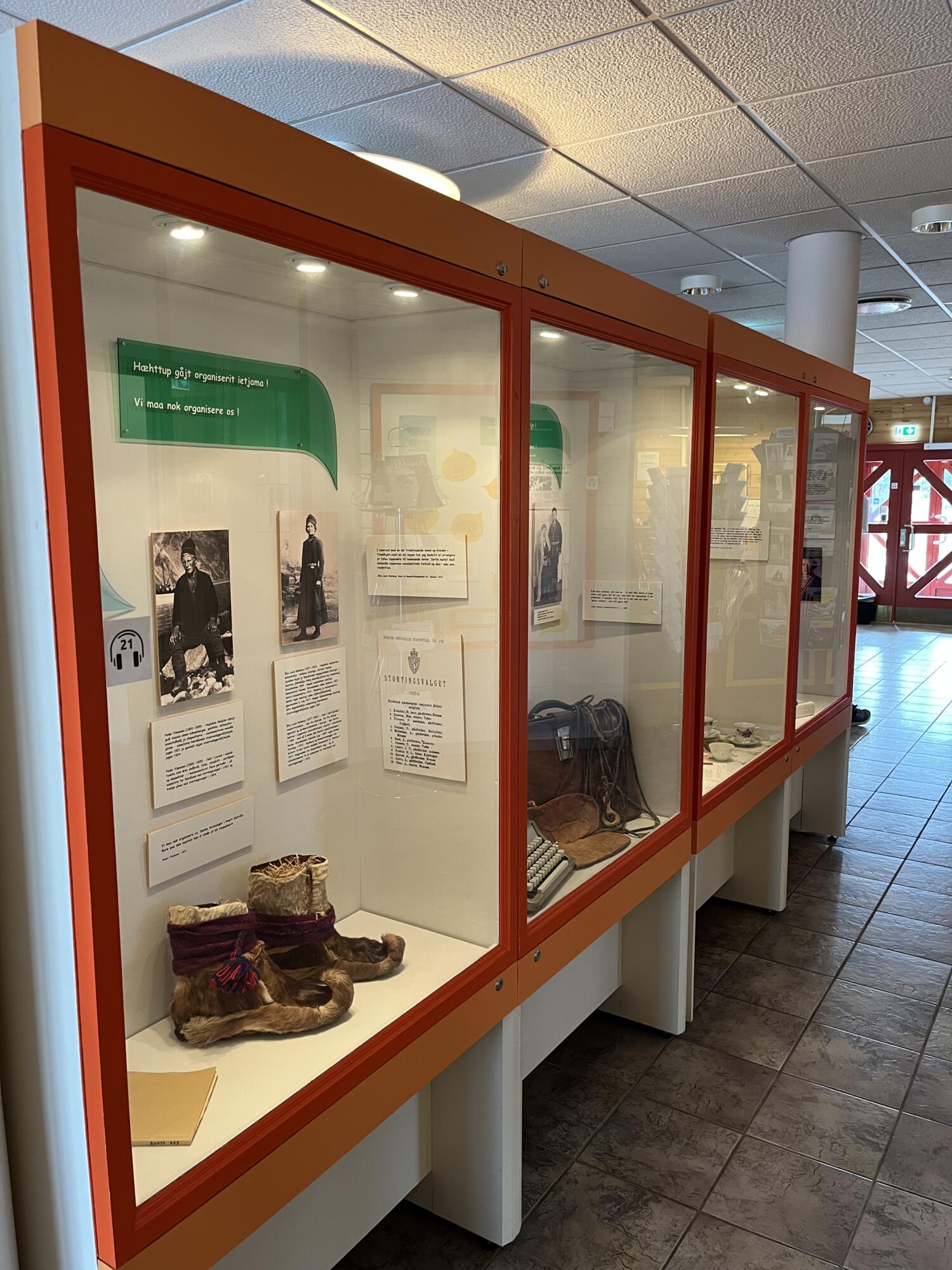
Showcases on Political engagement
This section of the exhibition traces the development of Sámi political and community organizing — from early pioneers in the 20th century to the institutional structures of self-determination that define the present day.
1) Early 20th Century: The Foundations of Organizing
The first display focuses on the early 1900s, a period when Sámi leaders began forming associations and advocating for political rights. One of the key figures during this time was Elsa Laula Renberg, a Southern Sámi activist and writer whose work helped catalyze broader Sámi political awareness.
Local leaders from this region, including Henrik Kvanndal and Peder Finnesen, also played significant roles in the development of Sámi political consciousness. Their efforts laid the groundwork for future movements by establishing the importance of organizing around shared cultural and social concerns.
2) Post–World War II: A Reawakening
Following the disruptions of World War II, Sámi political life entered a new phase. A quote from 1959, by Johan Johnsen, captures the spirit of renewed mobilization:
“…it’s time they wake up from their heavy, thousand year sleep of the Sleeping Beauty.”
This call to action reflected a broader sentiment — that Sámi voices, long marginalized, were returning to public life. Activists from Divtasvuodna/Tysfjord and surrounding areas helped establish both national and international Sámi organizations. Their focus included education, land use, language revitalization, and civil rights.
During the 1950s, national modernization policies often excluded fjord and inland Sámi communities. Infrastructure, such as roads, schools, and healthcare services, was not extended to all regions equally. In response, Sámi residents organized and mobilized politically.
Reflecting on the 1955 election in Tysfjord, community member Mikal Urheim stated:
“It was a Sámi election.”
For many, political participation during this period was not only a civic duty, but also a form of resistance — a way to oppose depopulation policies and affirm the right to live, work, and thrive on Sámi land.
3) Late 20th Century to the Present: Institutionalizing Self-Determination
The final two parts of the section moves into the contemporary period. In 1989, after decades of activism — including the nationally significant Alta–Kautokeino waterway protests — the Sámi Parliament of Norway/Sámedigge was established.
Its founding vision was:
“A diverse society based on the Sámi set of values.”
The Sámi Parliament holds elections every four years, and its members are drawn from across the Sámi territory of Sápmi. While the central institution is based in Kárášjohka (Karasjok), certain functions and initiatives are carried out at regional centers — including Árran, here in the Lule Sámi area.
This part of the exhibition demonstrates a central idea: Sámi political organizing is neither recent nor external. It is rooted in longstanding local traditions, collective decision-making, and community-based action.
From fjord settlements to national councils, from informal gatherings to elected institutions, Sámi political life has always reflected the strength and determination of communities working together.