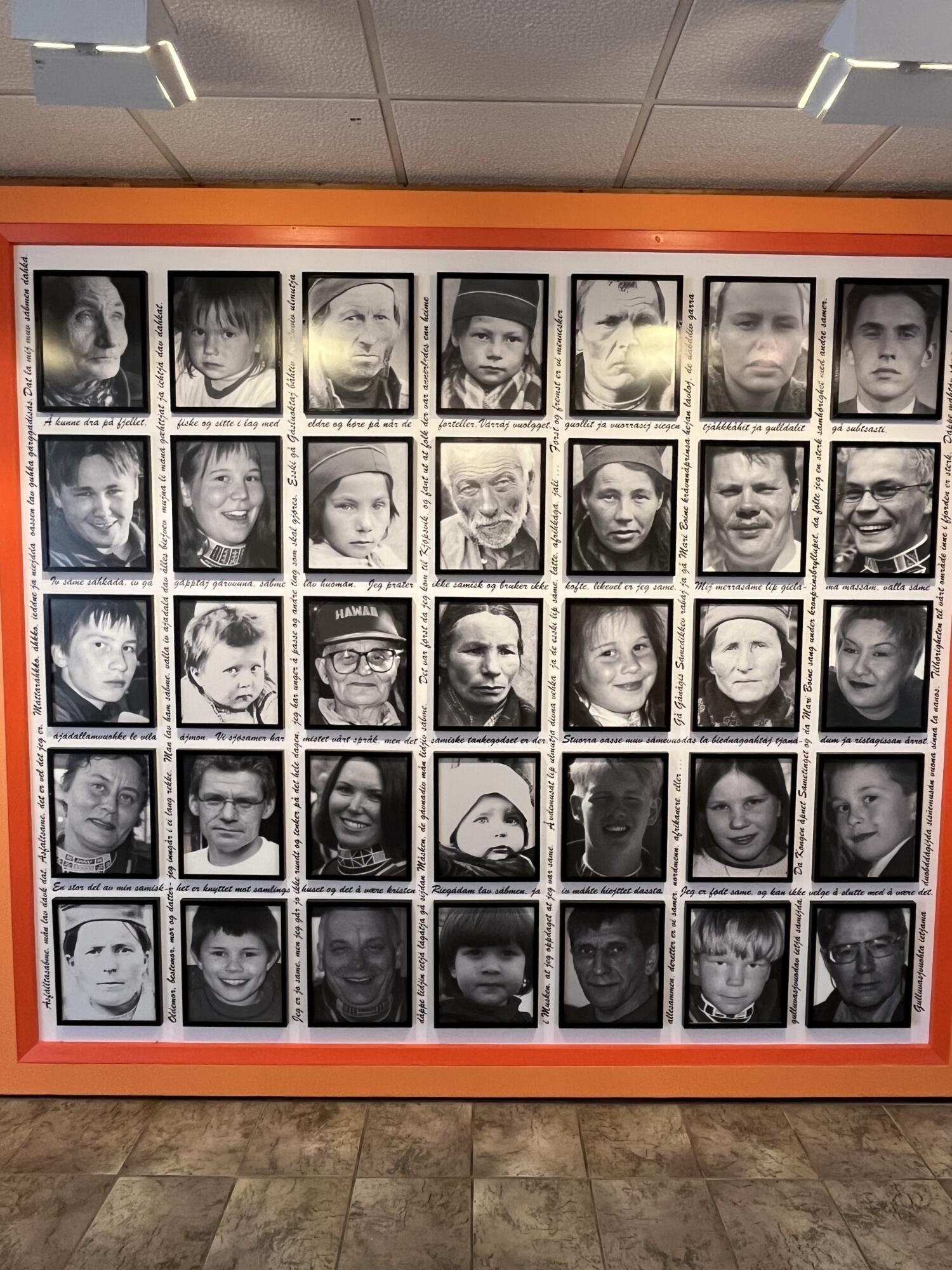

What makes me a Sámi?
This wall presents a series of portraits — Sámi individuals from a wide range of backgrounds and life experiences.
Positioned side by side, the images offer a powerful visual reminder that Sámi identity is not singular. While each person shares a Sámi background, every life and story is unique.
This section of the exhibition invites reflection on identity: What does it mean to be Sámi?
Is it defined by language, traditional clothing, ancestry, geography, belief — or by a personal sense of belonging?
Accompanying the portraits are a series of quotes, each responding to the same question:
What makes me Sámi?
Some speak of place:
“My feeling of belonging to our own area in the fjordland is strong.
Here, I can fully express my Sámi identity.”
Others reflect on lineage and heritage:
“Great grandmother, grandmother, mother and daughter —
I belong to a long line of ancestors.
This makes me Sámi.”
Several voices emphasize connection to nature and tradition:
“Having the opportunity to walk the mountains, go fishing,
and sit with the elders, listening to their stories…”
Urban Sámi perspectives are also represented:
“Social contact with other Sámis living an urban life
is essential to my Sámi origins.”
“Asphalt Sámi — that’s what I am.”
Some acknowledge a Sámi identity that does not depend on visible markers:
“Although I do not speak the Sámi language or wear traditional clothes,
I am still a Sámi.”
Others describe moments of affirmation and pride:
“When the King opened the Sámi Parliament,
and when Mari Boine sang at the Crown Prince’s wedding,
I felt a strong sense of belonging.”
Several quotes describe the discovery of identity over time:
“I didn’t know I was Sámi until I came to Kjøpsvik
and realized people there were different from those back home in Musken.”
For many, faith plays a central role:
“A large part of my Sámi identity comes from being part of the Laestadian congregation — and from being a Christian.”
Some contributors reflect on identity in broader human terms:
“First and foremost, we are all human —
then we are Sámi, or Norwegians, or Africans, or…”
Others express a grounded perspective:
“Although I am Sámi, I don’t walk around thinking about it all day long.
I have children to care for and other things to attend to.
I was born Sámi — I cannot choose to be anything else.”
Together, these voices form a multifaceted portrait of Sámi identity — complex, personal, and evolving. Each quote and each face adds depth to the understanding of what it means to belong in Sápmi today.