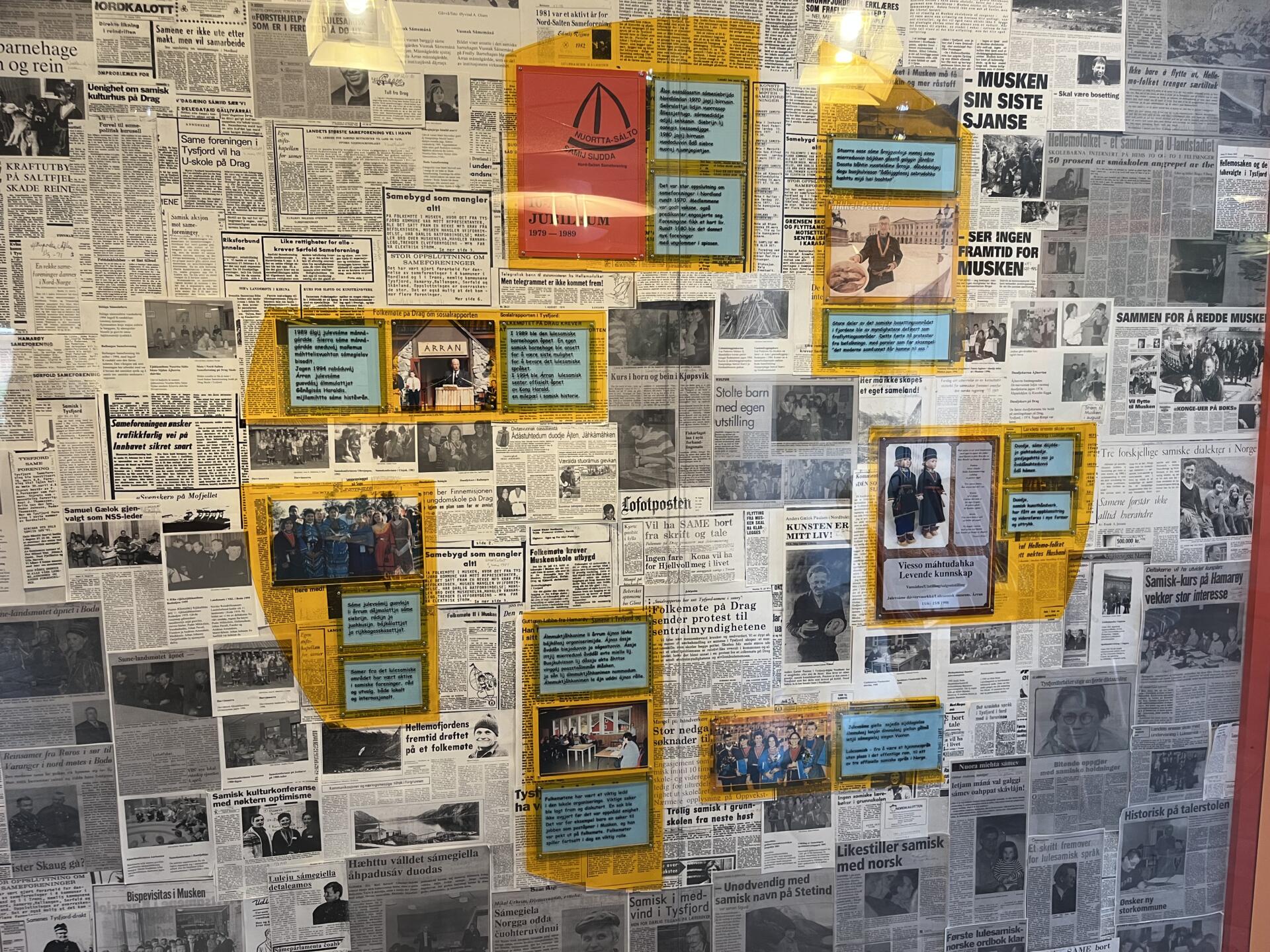
The Newspaper Wall
The wall before you presents a collage of headlines, photographs, and historical clippings. Together, they tell a story that is often absent from official histories and school curricula: the story of Sámi activism in the Lule Sámi area.
This is not a history of silence or passivity. It is a history of protest, organization, and resilience.
In the 1950s and 1960s, Norwegian government policies designated large parts of the fjord regions as “depopulation areas.” Residents were encouraged — or pressured — to relocate. Yet many resisted. Their protests were not against development itself, but against exclusion. They demanded the right to modern infrastructure and services within their own communities: “Let modern society come to us,” they said.
During the 1970s and 1980s, new Sámi associations were established, and the term Lule Sámi gained broader recognition. Local activists worked collectively for rights, political recognition, language preservation, and access to education and public services.
This activism was not only political — it was deeply personal.
In 1989, a Sámi kindergarten was opened in the region, viewed by many as a crucial step toward saving the Lule Sámi language. That same year marked the founding of the Sámi Parliament/Sámedigge in Norway — a milestone in Sámi self-governance.
In 1994, the Lule Sámi Centre, Árran, was officially opened by King Harald — a significant moment in Sámi cultural and political history.
Much of this work took place outside of formal institutions. Decisions were made at community gatherings, around kitchen tables, and in folk meetings. In these meetings, consensus was prioritized; a decision was not finalized until every voice had been heard.
One illustrative example occurred when only a single individual applied for the postal job in Måsske/Musken. The reason: he had already been selected by community agreement — reflecting the local approach to governance and trust.
Alongside political activism, there was a cultural renaissance. Duodje — Sámi traditional arts and crafts — were revitalized, often reimagined in modern forms. The Lule Sámi language, once confined largely to private homes, was officially recognized as one of Norway’s three Sámi languages. Representatives from this region participated in Sámi councils and conferences both nationally and internationally.
This wall does not merely present a timeline. It stands as a living testimony to the determination and collective effort of local Sámi communities — and to the ongoing work of cultural survival and renewal.
It reminds us that history is not only something that happens to people. It is something communities shape — together.