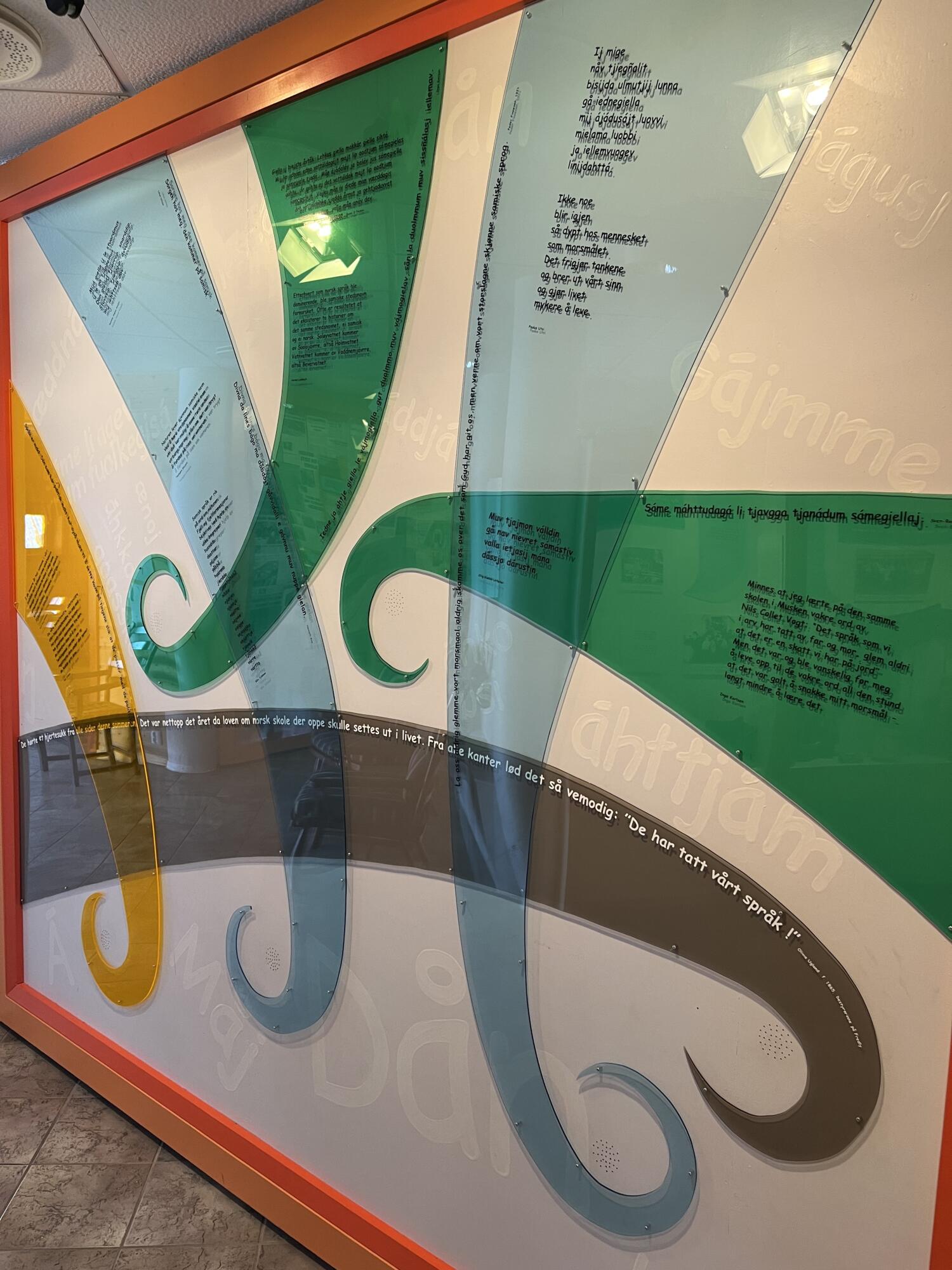

Language
This board presents the Lule Sámi language in both written and spoken form.
Today, Lule Sámi is experiencing a revival — a process of revitalization driven by local initiatives, education, and cultural pride. However, this resurgence follows a long period of suppression. Like several other Sámi languages, Lule Sámi is classified as endangered.
Throughout much of the 20th century, it was banned in schools, and children were often punished for speaking it — even in informal settings such as the schoolyard.
For many, the rejection of their language was not merely a policy, but a personal experience. Lule Sámi was often the language spoken at home, with family and elders. Its suppression represented a denial of identity and belonging.
Language is more than a tool for communication. It is a carrier of memory, emotion, and worldview. It is the medium through which people express love, grief, connection — and survival.
“When grief comes to me, it’s in Sámi.”
— Lillian Urheim
“Nothing is so deep-rooted in people as their mother tongue.
It releases thoughts, broadens the mind, and makes life easier to live.”
— Paulus Utsi
Lule Sámi, like other Sámi languages, is deeply connected to the landscape. Place names often carry detailed information about the terrain and environment — guiding travel, signaling where to find shelter, and marking seasonal patterns.
“Nature lives through Sámi names.”
— Thorbjørn Storjord
As Norwegian became the dominant language, many Sámi place names were replaced or altered. For example, Suolojávrre (“islet lake”) became Soløyvatnet, and Vaddnemjávrre (“beaver lake”) became Vatnvatnet — a shift that replaced Indigenous knowledge with standardized naming.
“As the Norwegian language became more dominant,
Sámi place-names became more Norwegian.”
— Harald O. Lindbach
The erosion of language also occurred through the naming of people. Along the coast, Sámi families were often assigned Norwegian surnames by clergy, removing cultural markers of Sámi identity.
“The clergy took their identity from them.
They were ordered to take ‘nice-sounding’ Norwegian names.”
— Kåre Tjihkkom
Today, there is a growing movement to reclaim Sámi family names such as Aira, Kuoljok, Tjihkkom, and Gælok, reconnecting individuals with heritage that had been obscured or erased.
“Language is power. Those who have political power also have the power to define reality.”
— Ole Henrik Magga
"A long drawn-out sigh was heard from all corners that summer. It was the year when the new law for Norwegian schools was to be put into effect. Everywhere, it sounded so mournfully: 'They have taken away our language.'" — Olivia Ugland
The survival of the Sámi language is a testament to resistance, care, and cultural resilience. Despite policies of assimilation and suppression, it endured — protected by communities, families, and individuals who refused to let it disappear.
“Let us never forget our mother tongue…
Protect our splendid and beautiful Sámi language.”
— Peder Finnesen, 1921
This story is not only about the past. It is about survival, dignity, and the right to speak — and be heard — in one’s own language.