
A brief introdction to Sámi history
In October 2023, we had the pleasure of welcoming guests from the First Nation, Cermaq Canada, and Cermaq Norway. This article on Sámi history was presented by Oddmund Andersen, the Head of Research at Árran.
Today, we find ourselves at the Árran Lule Sami Centre, an institution inaugurated by King Harald V in 1994. Árran lies in the middle of Sapmi or the Sami peoples land, in what we call the Lule Sami area. The Lule Sami are a Sami population with its own cultural characteristics and its own language. The settlement area of the Lulesamenes covers both the Norwegian and Swedish sides, stretching from the eastern Swedish coast to the western Norwegian coast. The name 'Lulesame' or Lulelapp is old and mentioned in written sources already from the 17th century.
The history of settlement in our region stretches far into the past. Approximately 20,000 years ago, this area was covered by ice. As the ice began to recede and reveal land, opportunities for habitation arose. It didn't take long for the first signs of human presence to emerge. These early inhabitants left behind rock carvings grinded into the stone, dating back around 9,000 years. There are pictures drawn, in natural size of animals they knew, such as reindeer and moose, killer whales, swans and boats. These people were hunters and gathers, with a mobile settlement.
While ethnicity is challenging to pinpoint in such ancient times, it's reasonable to assume that these early people were part of the proto-Sami community. Over time, evidence of what we can categorize as Sami culture gradually emerges, dating back approximately 3,000 years. The Sami people left their mark with distinct housing and burial practices. In our region, the oldest known graves are around 1500- 2,000 years old, known as scree graves. The Sami culture also becomes evident through other religious and ritual practices, including reverence for the bear. The bear was considered a sacred animal by the Sami, and its remains were customarily buried. In our region, we can find bear graves, some nearly 2,000 years old.
Thousend year back in time, the Sami population primarily occupied the fjord regions and the surrounding lands,. In ancient sources, these lands were referred to as 'Finnmork' by the Norse or Norwegian population, because they used the term "Finner" about the Sami. There was significant interaction between these two ethnic groups, driven by trade. In the east and north, various other trade groups engaged with the Sami, exchanging goods and levying taxes. The Sami were renowned for their fur products, highly sought after in Europe, which enriched our region. In return, the Sami likely gained access to agricultural products such as grain and milk. Additionally, numerous jewellery and treasure finds suggest exchanges between different trading groups.
Around a thousand years ago, we witnessed a shift in the Sami economy. Previously, the Sami were predominantly hunters and gatherers with a mobile lifestyle. Now, we observe a transition to reindeer husbandry, initially with a small number of animals that were also milked. Reindeer were used as both pack animals and transport. Over time, reindeer herds grew, and there was seasonal migration between the coast and the inland areas, spanning present-day Sweden and Norway.
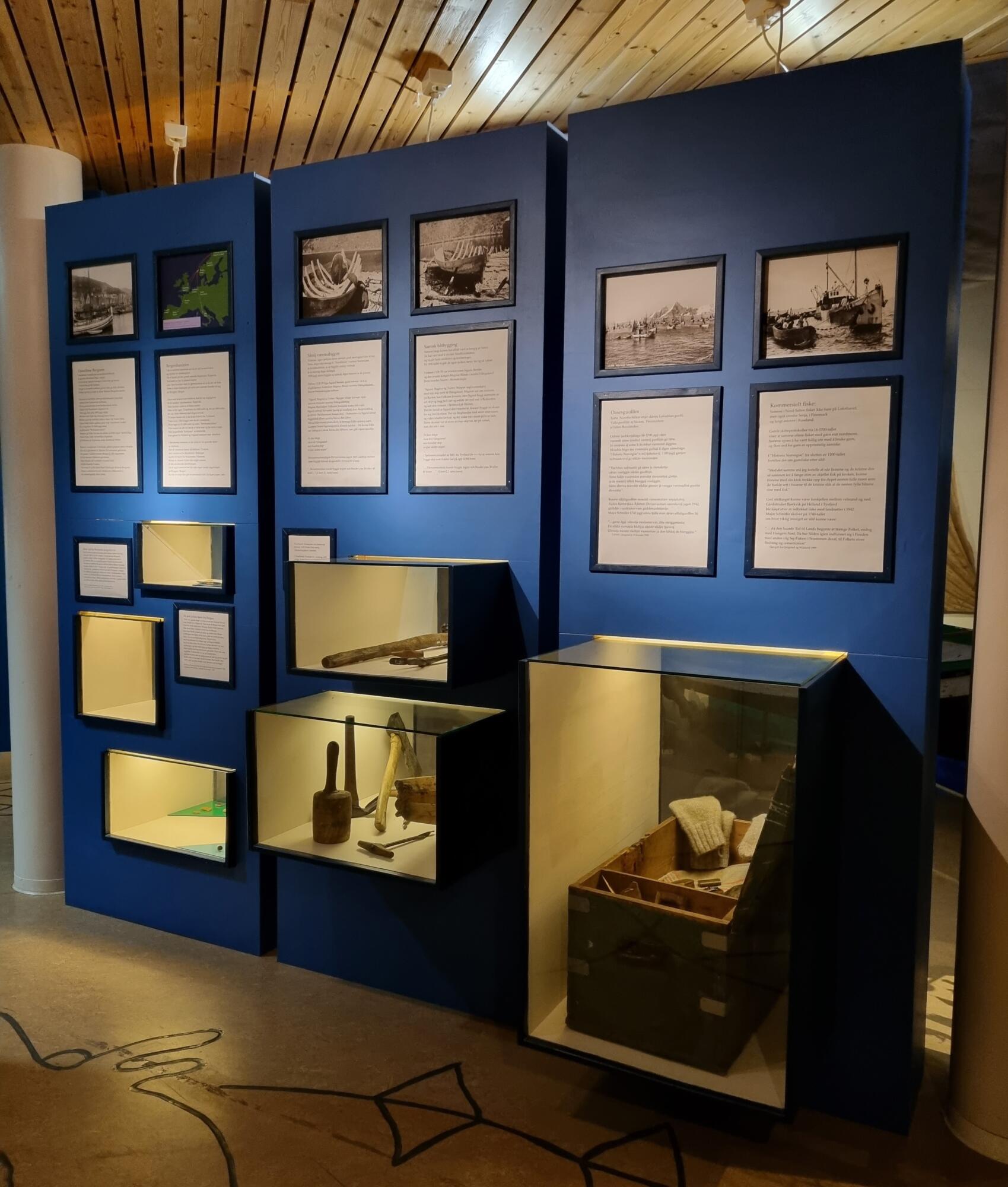
We also see changes in Sami subsistence with the introduction of small livestock and later, arable farming. Commercial fishing became another significant source of livelihood, especially with participating in the large fisheries. The Sami were also known as skilled boat builders. According to a source from the 12th century, they were said to have constructed the fastest and most agile boats, making them difficult to catch when their sails were hoisted.
Through the Middle Ages. the pressure on Sami territories increased as surrounding ethnic groups demanded taxes, leading to their integration into the surrounding states. Eventually, national states exerted control over Sami lands, resulting in the division of Sapmi among different states.
In this region, after a war between Denmark-Norway and Sweden, the coastal areas became part of Denmark-Norway in the early 17th century. Nevertheless, the border between the two countries remained unresolved until the mid-18th century. The Reindeer Sami, who traversed the coast and inland areas, secured the right to cross the border through an addition to the border treaty known as the Lappekodisillen.
In the 19th century, following Norway's independence, pressure on the reindeer herding population intensified. At a 1919 convention, reindeer were banned from their northern territories, forcing them to move southward. These forced relocations sparked unrest in many Sami regions.
Simultaneously, Norwegian policy towards the Sami underwent changes. Several directives, including the Wexelsen poster, enforced a policy of Norwegianization against the Sami population. Speaking Sami at school was prohibited in many areas, and in some areas, teachers were tasked with preventing children from using Sami during breaks. Formally, the Wexelsen poster remained in effect until the Norwegian Parliament considered the Sámi committee's recommendations in 1963. However, some argue that Norwegianization persisted, with a potential halt in 1979-1980, notably tied to the development of hydropower, known as the Alta-Kautokeino development. Others believe that Norwegianization policies may still be ongoing today.
Nevertheless, there have been positive policy changes towards the Sami population. The Sami Parliament was established in 1989, consisting of representatives elected by the Sami themselves. The Sami Parliament addresses all matters that impact the Sami people, as determined by its members. In 1998, the Norwegian Parliament introduced an addition to Norway's Constitution, § 110a, acknowledging the Sami and their relationships. It mandated by state authorities to facilitate the preservation and development of Sami language, culture, and social life. Our institution stands as a testament to these positive policy shifts.
Through the last decades, the Sami community has therefore experienced a period of prosperity. In school many Sami children are taught in Sami language, Sami place names appear on road signs and Sami is present in most occupations today, including fish farming.
Thus, in this way, we have encapsulated ten thousand years of history in a mere ten minutes.