
Trading in Bergen & the Trumpet of Nordland
Centuries ago, the harbor in Biergun/Bergen would have been filled with the sounds and scents of maritime life — the creak of boats, the smell of dried fish and smoke, and voices speaking across languages and regions.
This bustling port served as a central hub in a trade network that extended far into Northern Norway, reaching even the Sámi settlements of the fjords and mountains.
In the two lower display cases of this exhibition are fragments of pottery and clay tobacco pipes uncovered at the old Sámi settlement in Gásluokta/Kjøpsvik. These pieces, accompanied by reconstructions, offer a glimpse into the material culture of coastal Sámi communities — and their connections to broader trade routes.
Though small and worn, these items provide important clues. They reveal how Sámi fisherman-farmers engaged with distant markets, including those in central Norway and abroad.
At home, meals were often shared from communal ceramic dishes, such as those produced in Tråante/Trondheim between the 17th and 19th centuries. Some of these plates feature fingerprint impressions from the potters — details still visible today.
Imported goods were also part of domestic life. White wine from Germany, for example, was transported in wooden barrels like those displayed here. These kegs, dating from the 1500s and 1600s, were traded in Bergen and carried northward aboard cargo boats.
After meals, both men and women may have smoked tobacco using long-stemmed clay pipes — often referred to as “chalk pipes.” These came from England and the Netherlands, along with the tobacco they were made to hold.
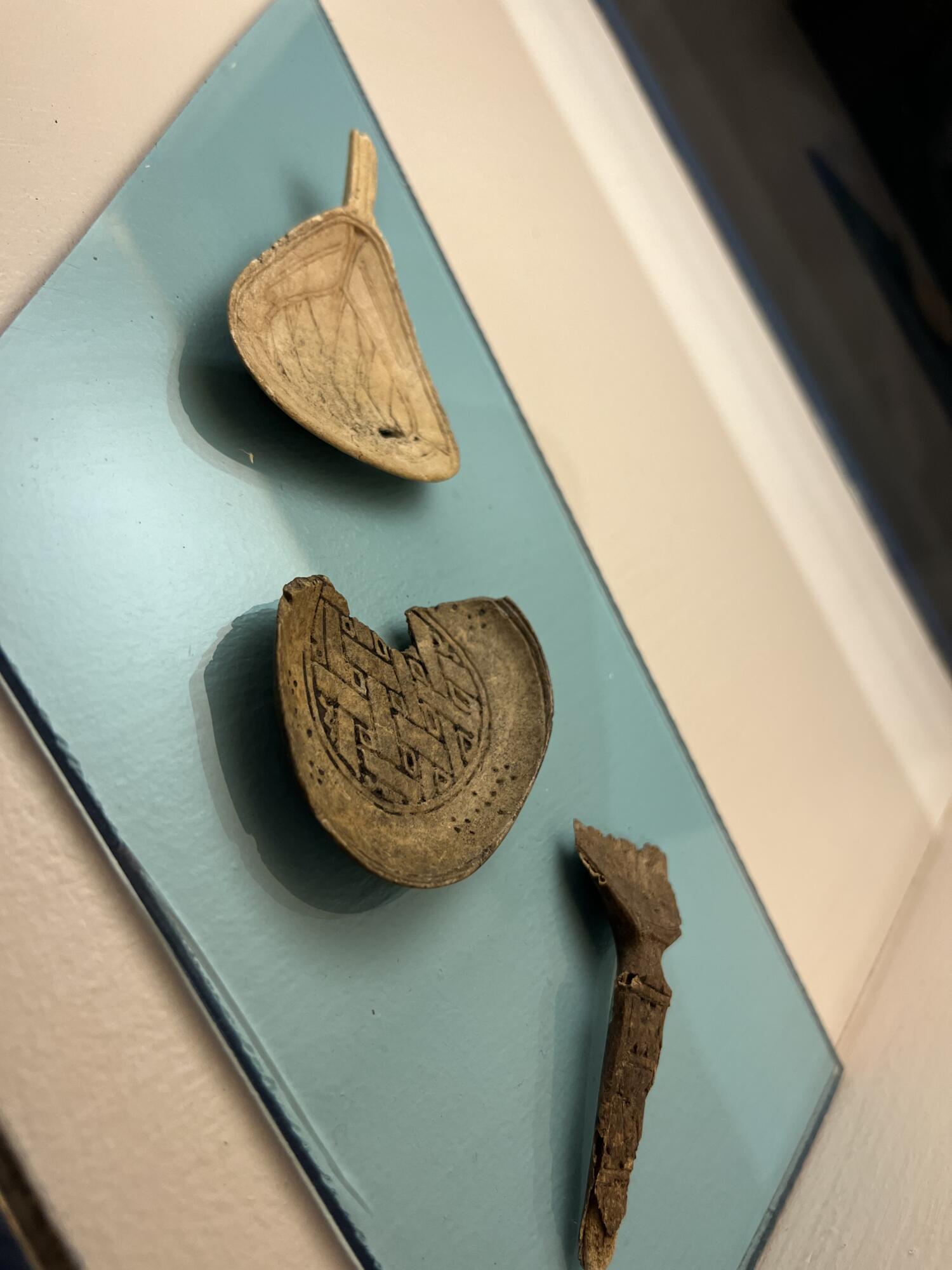
The upper showcase features three engraved spoons carved from reindeer horn. They originate from Ájladde/Helland in Divtasvuodna/Tysfjord, Gálldo/Kjeldebotn, and Strávnjunnje/Straumsnes in Hábmer/Hamarøy. Such spoons were commonly traded or sold to coastal populations and valued as both practical tools and decorative items.
Some horn spoons have even been discovered during archaeological excavations at Bergen’s old docks. Certain designs were so appreciated that silversmiths reproduced the engraved patterns — not in horn, but in silver.
All of this — fish, horn, wine, tobacco, and crafted goods — moved along the coast by boat. Smi communities were not isolated; they were active participants in regional commerce, maritime skill, and cultural exchange.
This tradition of craftsmanship and seafaring was acknowledged in literature as well. Around 1690, priest and poet Petter Dass wrote in The Trumpet of Nordland:
“There the Sami chop planks and boards,
from which are made the most loving cargo boats
that have ever been found on the currents.”