
Racial Research
This section of the exhibition addresses a painful and difficult period in Sámi history — one marked by exclusion, racial science, and quiet forms of resistance.
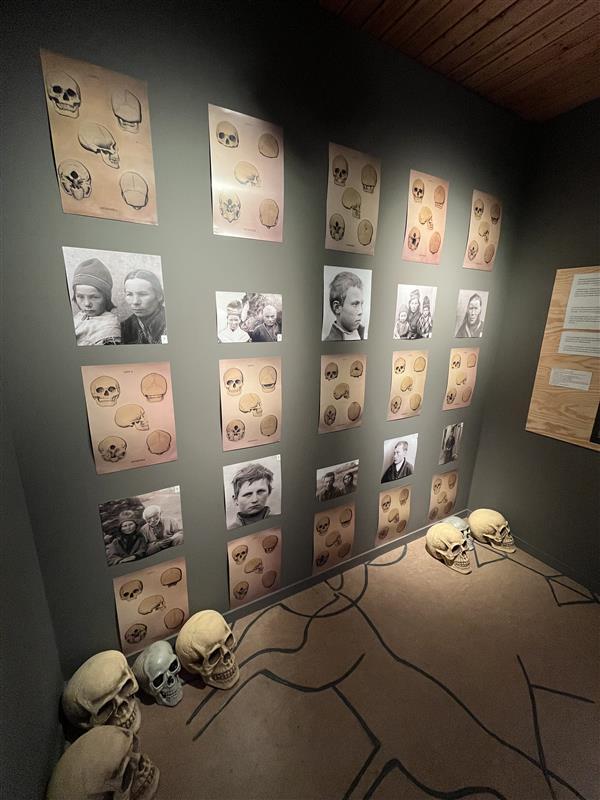
Displayed on the surrounding walls are portraits of Sámi individuals, photographed in still, rigid poses. These are not family portraits, nor were they taken with consent for personal remembrance. They were part of a large-scale project in racial anthropology conducted in Norway during the early 20th century — a time when it was widely believed that people could be scientifically measured, categorized, and ranked based on physical traits.
Researchers visited areas including Divtasvuodna/Tysfjord in 1914 and 1921. During these expeditions, approximately 210 Sámi individuals were examined. Some were photographed in the nude. Others were subjected to up to 28 physical measurements, including head circumference, nose length, and eye spacing. The photographs seen here are products of that process — individuals reduced to data, their identities overwritten by a pseudoscientific effort to define racial "types."
The primary researcher behind the Tysfjord study later published a report in 1932 titled Tysfjordlappen. In it, she concluded that Sámi individuals had “smaller foreheads,” which she claimed — without scientific basis — indicated lower intellectual capacity compared to ethnic Norwegians. The shape of the skull was used to support racist theories about intelligence and racial hierarchy.
This type of thinking aligned closely with the ideology that would later be used by the Nazi regime to target Jews and other marginalized groups.
The research extended beyond the living. Displayed on the floor are replicas representing over 1,000 Sámi skulls exhumed from graves between 1850 and 1977. These human remains were excavated by Norwegian scientists, often under official institutional support, and transported to scientific collections in Oslo and abroad. Many were stored, labeled, and studied without the knowledge or consent of the deceased's communities or descendants.
In some cases, researchers paid for access to graves — offering five kroner per skull — treating human remains as scientific specimens rather than as ancestors.
These actions were not isolated. They were part of a broader state-sanctioned ideology of assimilation and racial classification, legitimized at the time as scientific inquiry.
Today, such practices are widely recognized as racist and deeply dehumanizing. Yet their impact is not confined to the past. Many of the photographs, skeletons, and archival materials remain in institutional collections. Efforts have been made to repatriate the remains to their families or communities, but in many cases, names were never recorded. Identification is often difficult or impossible.
This part of the exhibition is confronting. It challenges the viewer to reflect on how science and policy have been used to justify discrimination — and how the legacy of these actions continues.
Behind every face photographed was a life, a name, a story — and a person who did not choose to be remembered in this way.
This space seeks to restore dignity, remembrance, and truth to those individuals.