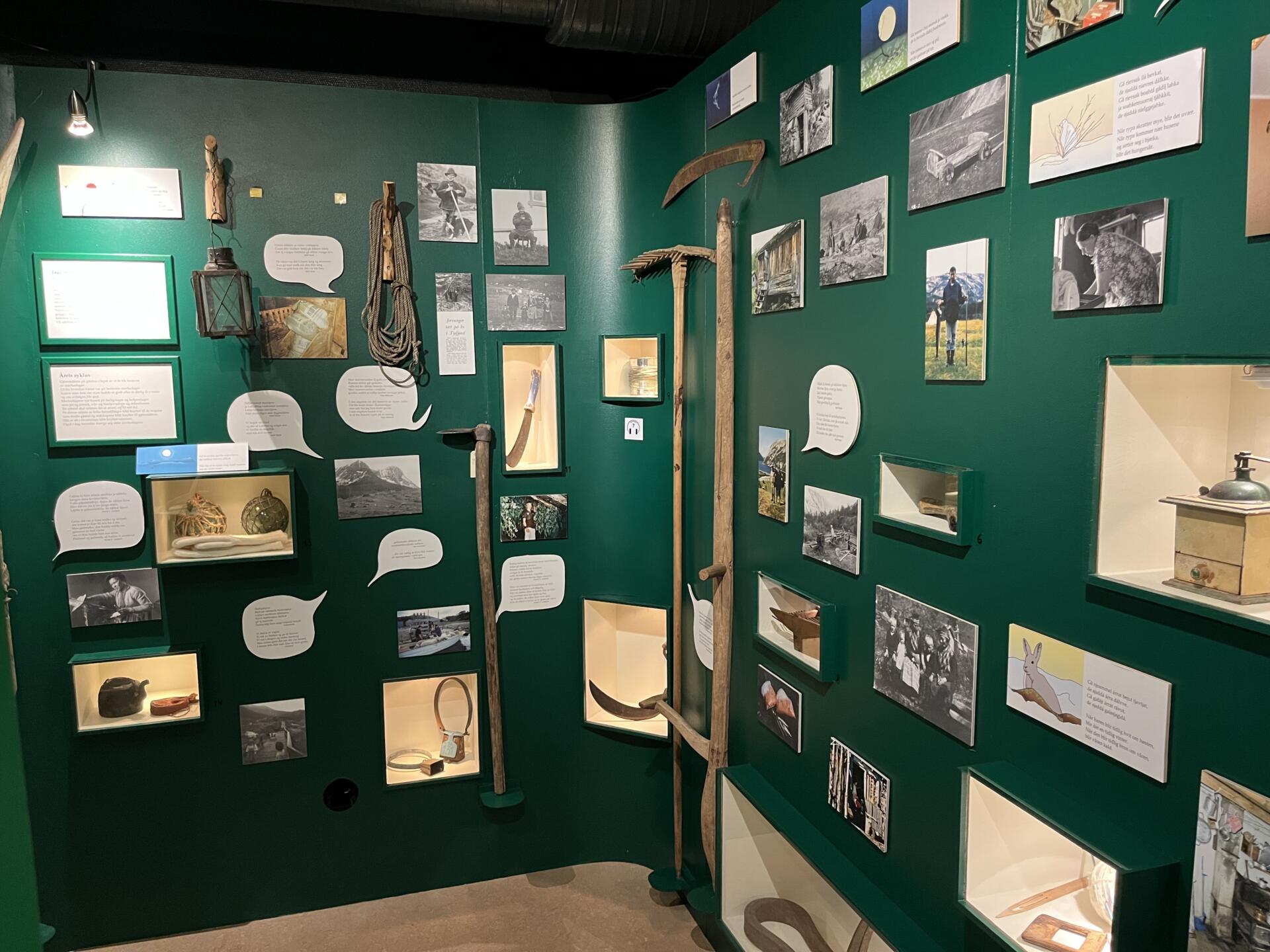

The Year’s Cycle
The daily and seasonal rhythm of life on a Sami farm was shaped not only by weather and landscape, but also by the calendar of belief.
Throughout the year, work followed the guidance of red-letter days — a term referring to holy days, saints’ days, solstices, equinoxes, moon phases, and major observances such as Christmas and Midsummer.
Signs in nature were closely watched. A sudden storm or clear sky on a red-letter day was often interpreted as a prediction of the coming season — whether it would bring a good harvest or hardship.
Tasks were performed in a specific sequence, each one opening the way for the next. Tools, knowledge, and natural cycles were all interwoven.
A common saying expressed this worldview:
“Everything which exists is connected.”
In some communities, this principle is still reflected in the timing of farm work according to the traditional calendar.
When times were difficult, people adapted resourcefully to survive. Oral histories and local testimonies provide insight into these strategies:
“The goat — it was milk and skin. Not meat. But goat’s milk… it saved us one whole winter. Crispbread and goat’s milk — that was enough.”
— Harald O. Lindbach
“In spring, we fetched seaweed and reindeer moss. It made the cow give more milk when hay was scarce.”
— Adolf Nystø
“We chopped firewood, loaded a cargo boat, and sailed to Lofoten to sell it.”
— Adolf Nystø
“When I was young, we caught hundreds of ptarmigan. Mostly with snares — I used a gun.”
— Peder Mikkelsen
In times of scarcity:
“We stripped bark from rowan trees, dug up heather… You did what had to be done. You didn’t get much for free.”
— Anonymous informant
“The horse ate best. Stood there fat and full, while the other animals crept out of the cowshed in spring.”
— Harald O. Lindbach
Despite hardship, communities endured through innovation and hard work:
“They planted potatoes and corn, and kept as many animals as they could feed.”
— Thorbjørn Storjord
“We even brought a horse to pick cloudberries — though once it ran off in the night, right toward the Swedish border.”
— Adolf Nystø
Nothing went to waste:
“Sheep’s wool was for clothes — and for the sails. How would you even get to Lofoten without woollen socks and mittens?”
— Harald O. Lindbach